Cecilia Granara: Tempesta, Tarot, and Transformation
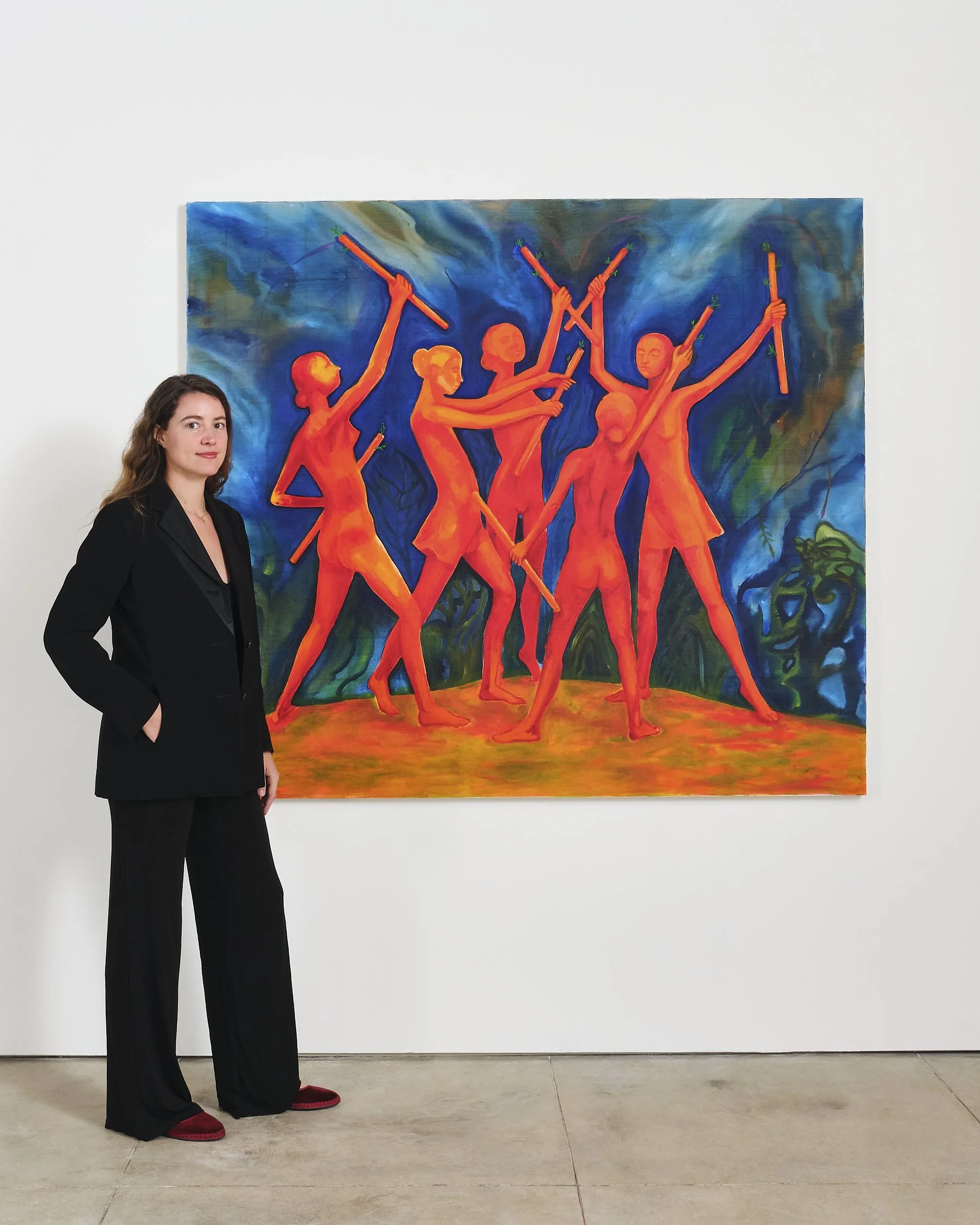
Cecilia Granara (b. 1991, Saudi Arabia) is a painter living and working in Mexico City. Her solo exhibition Tempesta is currently on view at Charlotte Call Gallery in Los Angeles. Over the past several years, Granara’s practice has become increasingly attuned to ancient iconography, tarot symbolism, and mystical visual languages that act as vessels for psychological and spiritual transformation. In this conversation, the artist reflects on how her recent move from Paris to Mexico has shaped the journey of her practice: expanding her understanding of how images can activate the subconscious, strengthening her confidence in colour, and deepening her search for forms of connection that extend beyond the individual through nature and collective ritual.
Granara’s paintings emerge through an intuitive process that begins with images encountered in the mind’s eye. Drawing from dreams, subconscious intentions, and her interpretations of symbolic archetypes, the works gradually take shape through successive layers of colour and form. Rather than beginning from a fixed narrative, the artist allows meaning to surface slowly as the painting develops, embracing intuition, chance, and transformation as central elements of the process.
The exhibition also marks a shift in Granara’s practice toward figures that feel increasingly sculptural and embodied within luminous, atmospheric fields of colour. Often depicted in moments of collective ritual, meditation, or transformation, these figures appear both grounded and present, reflecting the artist’s growing interest in representing volume and physicality within imagined, fluid environments.
Throughout Tempesta, Granara’s figures seem to move toward a state of greater freedom and agency, depicting powerful, fearless women who embody both vulnerability and strength. In this sense, the paintings function not only as reflections of inner landscapes but also as outward manifestations: images of a world shaped by intuition, ritual, and connection, and of the kind of reality the artist hopes might one day come into being.
In our conversation in 2021, you spoke about Tarot cards as a source of inspiration in your practice. Since then, your work has become even more deeply aligned with Tarot imagery and ancient symbolism. How does the nature of iconography, perception, and interpretation play a role in this new body of work?
The question of interpretation of iconography has fascinated me since my student days at Beaux-Arts in Paris, especially in François Renée Martin’s class on “The Most Difficult Works of Art to Interpret in the History of Art.” One class focused on allegory in the Italian Renaissance. It’s no wonder that Tarot, born in 14th-century Italy and rich with layered symbolism, felt like familiar territory.
I’ll admit it’s sometimes nerve-wracking to say publicly how much I love Tarot. Many view it as irrational, superstitious, or even evil. Yet I need daily contact with mysticism. What is mysticism? I like how Simon Critchley puts it in his book On Mysticism: The Experience of Ecstasy: we all crave practices that free us from habitual thinking, allowing us to stand ecstatically with what is. For me, painting and Tarot are exactly those rituals that shake me out of myself and help me surpass my ordinary and therefore limited thinking.
To answer your question more precisely, since 2021, I really went deep with Tarot. I studied with Vicki Noble (creator of the Motherpeace Tarot), taking beginner, then advanced courses that deepened my understanding of psychic insight, and how images awaken the subconscious. I’ve also read three books on Tarot by Susan Chang, among which was a practical work-book to self-educate on how to apply the mystical logic of tarot to everyday life. It's called Living Tarot and I highly recommend it to anyone who wants to learn to read tarot. In 36 Secrets, Chang pushes us to consider how we use hidden knowledge to fabricate meaning. I believe that is the same question I ask when I paint.
This second solo show with Charlotte Call has been years in the making, and she knows I’m so deeply drawn to the 78 cards, that we even considered doing a show where I presented 78 personal interpretations of the cards and then published them as a commercial deck. But I see that as a lifelong project with its own pace.
Tempesta draws on Tarot’s logic and some of its iconography. Only the paintings Calm Before and Dance, Tempesta (5 and 8 of wands) clearly reference the tarot. For the rest of the show, the Tarot influence is more in the conceptual framework I use to create my work. As I understand it, when you shuffle a deck, you engage with chaos, letting constellations of meaning appear through imagery and intention. That is how I created this show.
Many of your figures are in the midst of ritualistic actions - dancing in Dance, Tempesta (5 and 8 of Wands), performing yoga warrior poses in Stillness, connecting to a tree in Presenza, or bathing in sunrays in Calm. What do these rituals represent for you?
Like everyone else, I crave what Critchley described as the “desperate desire for the touch of love”: a connection to something larger than the self. Some people would call that “the divine”. These rituals point toward a temporary dissolution of the ego: when we feel anxious or depressed, one way forward is to reconnect with something outside the self.
In Dance, Tempesta (5 and 8 of Wands), I painted people dancing in a circle because collective dancing can create that feeling of connection. We all know it: dancing with friends without censoring yourself, or being in a crowd at a concert at the peak of a singer’s note, when everyone cries and sings at the same time. There is something so healing to witnessing art collectively. For this painting I looked at the tarot card “Five of Wands” and reimagined its composition with five female dancers. The scene is traditionally masculine and conflictual, with men playfully striking each other with sticks in broad daylight. I changed it to women dancing in a storm at night, their sticks transformed into batons or magician’s wands.
In Stillness, I was thinking of the sculpture of a dancer by Edgar Degas at the Musée d’Orsay, but several people have read it as the standing splits in yoga. She is surrounded by a cat, a snake, and a ghost-like hand. I think the unfriendly cat is that part of the self that loves to curl up in a ball and rest (and don’t you dare disturb it). The snake is baffling to me, it shows up in my paintings regularly. It’s an incredible visual device that breaks all lines, which is the original reason I wanted to include it. But its symbolism is so much about shedding skin, regeneration, transformation…more on that later!
In Presenza, that character touching the tree is like an avatar of my husband. I just painted a simple ritual we did together once, which is rooted in practices he learned from his spiritual teachers about connecting to the energy of nature.
These rituals are about how to move through storms. How to acknowledge and respect the storms within us and around us.
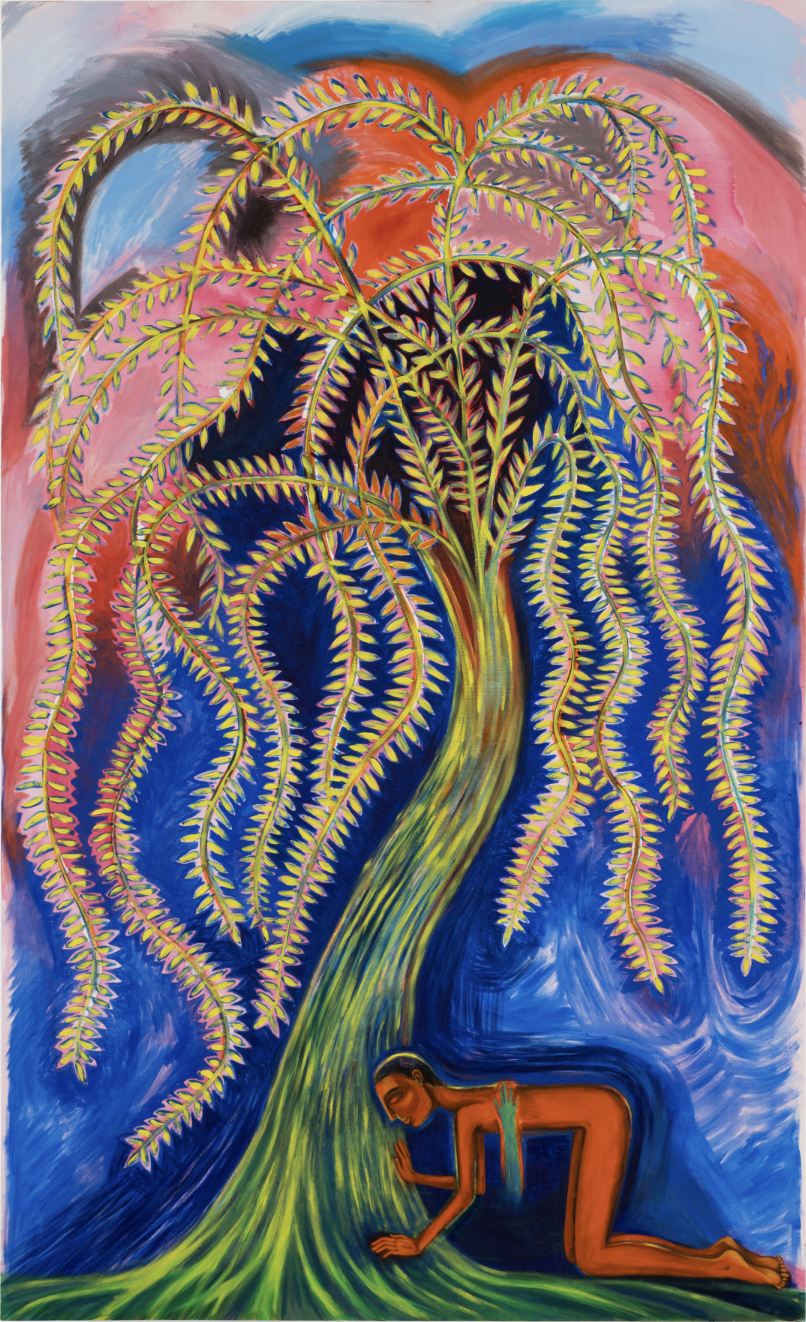
Presenza, 2025. 180 × 110 cm. Acrylic and oil on canvas.
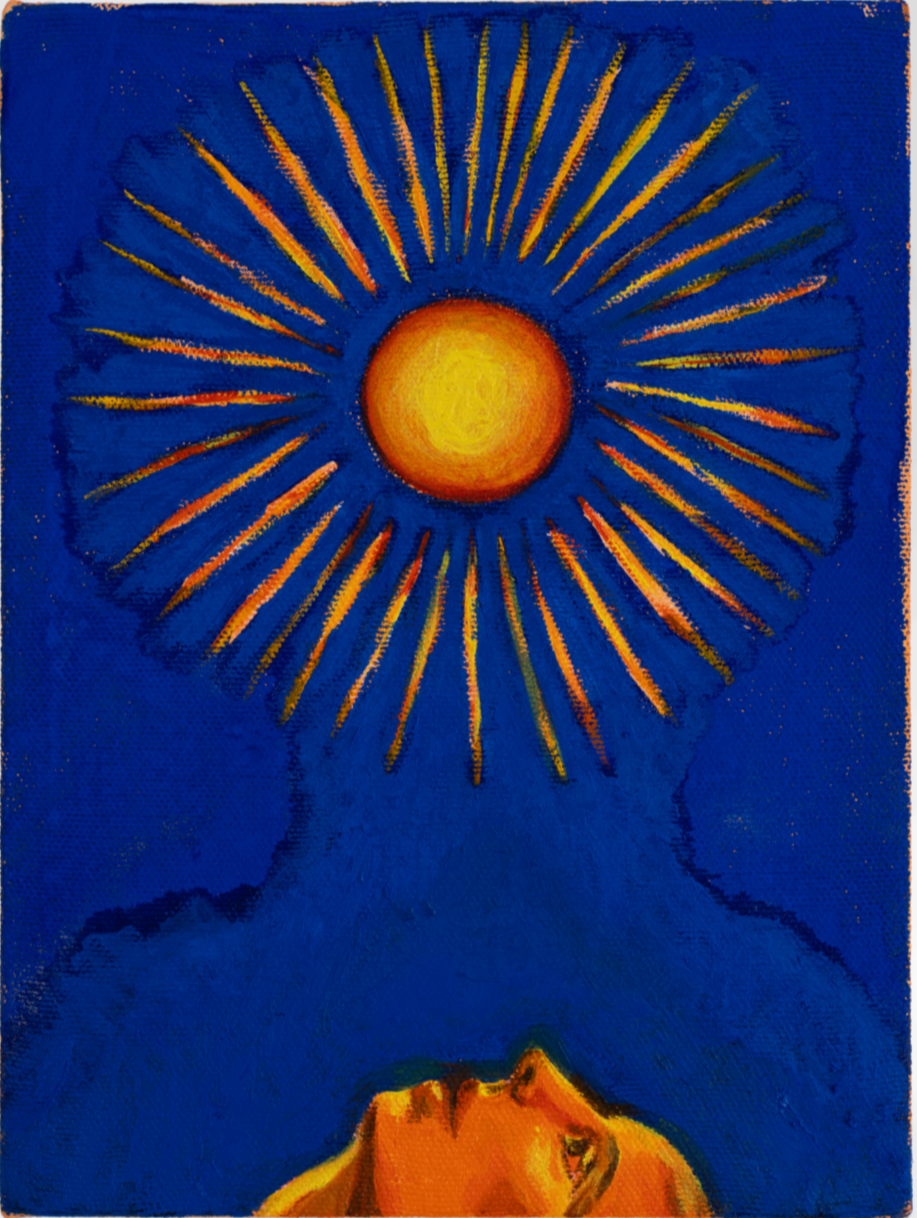
Calm before, 2025-2026. 24 x 18 cm. Oil on carbonate calcium preparation on canvas.
What role do spirituality, the subconscious, and dreams play in your practice? How much do you plan each painting in advance, and how much do you allow intuition or chance to guide the final result?
At the beginning of a work, I draw very freely, following images that attract me without trying to interpret them. I don’t plan anything except the composition. I relate to what Alberto Giacometti said: that he didn’t understand something until he drew it. Painting is a way for me to investigate inner and outer worlds.
Once I'm at the third layer of paint, something starts happening where everything begins to look and feel more “solid”. That’s when it’s harder to fix any mistakes, and it looks better to add than to subtract elements. And I let intuition and chance guide me to the very end. Sometimes I can turn a mistake into a really gorgeous part of the painting, like the ghost hand in “Stillness”. Sometimes I realize an element is missing or an element is too much at the very end, and I have to radically change the painting! That’s a frightening moment. You could ruin everything you’ve been working on for months. But if your inner voice is telling you, listen. My drawing teacher always said, drawing is just moving things around until they are in the right place. Painting is just drawing with different materials. It’s constant decision making.
As for dreams, I started dream integration therapy almost a year ago. I had the nagging feeling that my subconscious was sending me messages I hadn’t been trained to understand. How could I ignore the treasure trove of imagery that is being offered to me every single night?
I’ve started to control my dreams through Lucid Dreaming techniques. When I control a dream, it feels similar to when I execute a successful decision to improve a painting. I hear a strong, clear inner direction. That’s a rare and precious sensation in these confusing times. ‘Black Horse From a dream’ is my first painting to come from the image bank of my dreams.
If it feels right, I'll keep using that source. For the moment I'm in the testing phases.
I noticed that you painted both a snake and a horse in this body of work, which reminded me of the recent Lunar New Year transition from the Year of the Snake to the Year of the Horse. In the Chinese zodiac, the snake symbolises transformation and the shedding of old layers of skin, while the horse represents momentum and a leap toward freedom and vitality. Were these associations on your mind at all while you were working on these paintings?
A friend of mine, a university professor who teaches aesthetics and knows a lot about astrology, noticed the same thing when she visited my studio. How incredible…but honestly it was completely subconscious!
As I mentioned, the black horse came from a dream. The snake in “Stillness” was a visual device that made the eye travel around the painting in a more exciting way, because without it the composition was very rigid.
Amazingly, I started these paintings at the end of 2025 and finished them at the beginning of 2026, so that lines up as you noticed, with the symbols representing the energy of one year transitioning to the next. I do think we share forms of collective subconscious imagery, so it’s fascinating when these kinds of symbolic synchronicities appear universally.
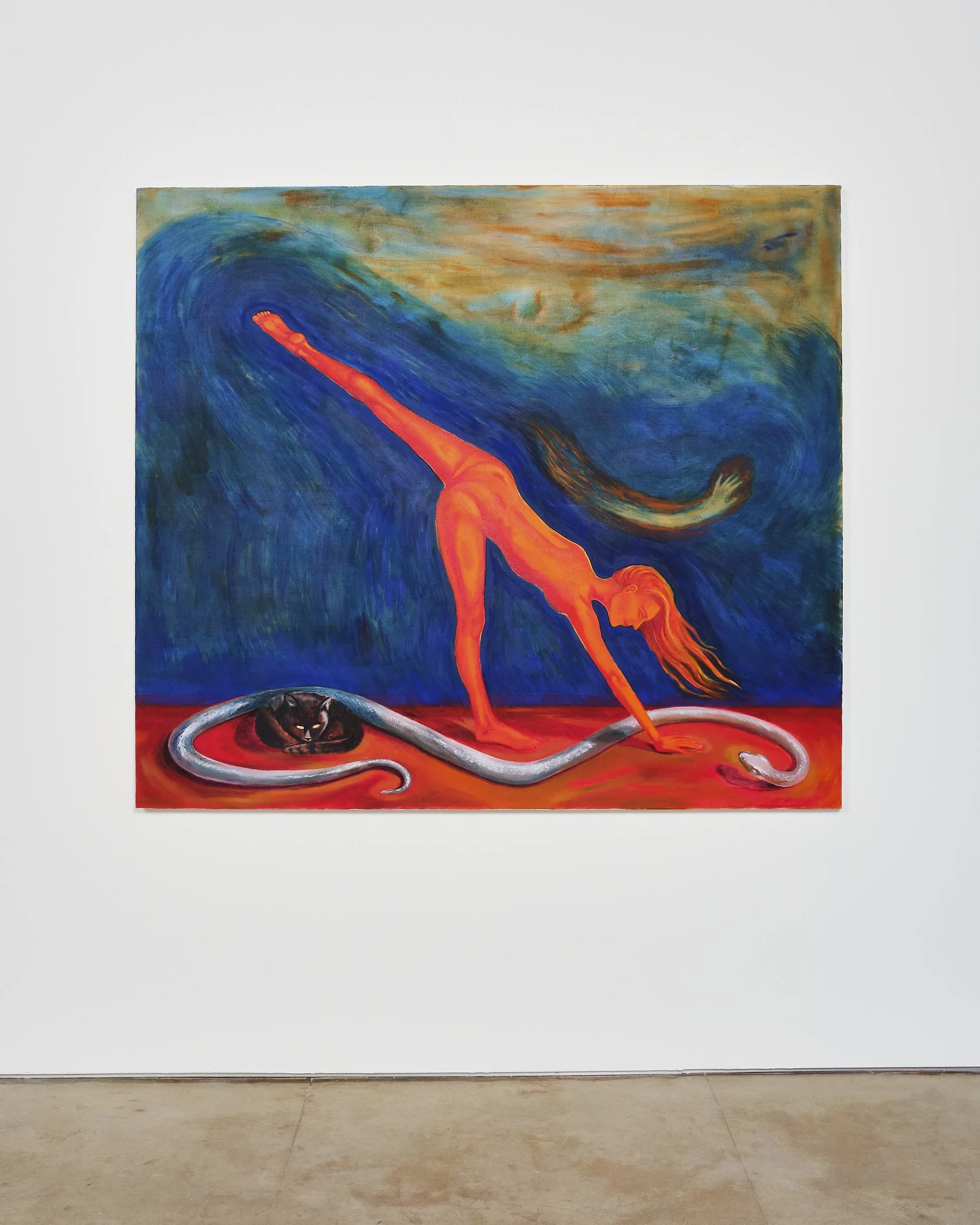
Stillness, 2026. 150 x 170 cm. Acrylic on canvas.
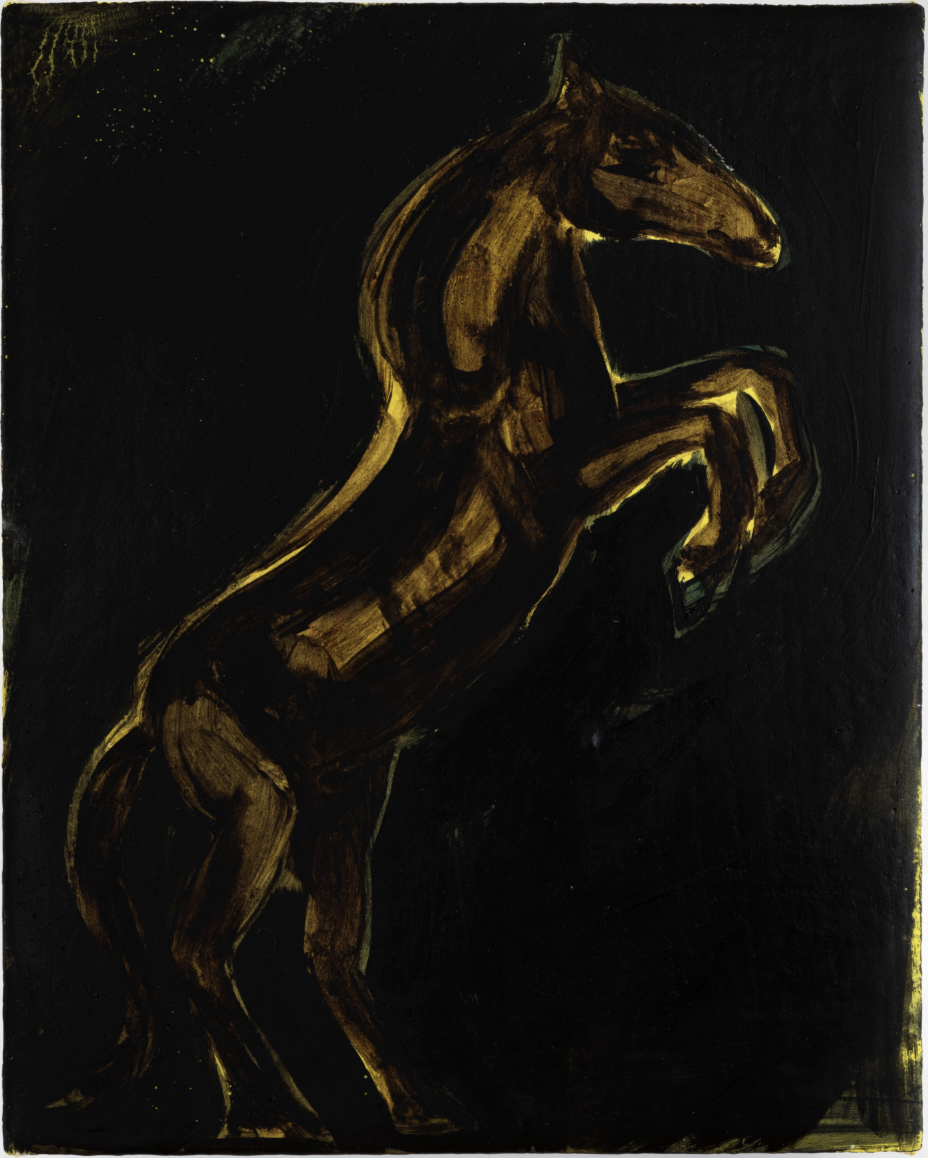
Black horse from a dream, 2026. 25 x 20 cm. Oil on carbonate calcium preparation on canvas.
Your move from Paris to Mexico marked a significant shift in geography and cultural context. In what ways has this transition shaped the energy, colour palette, or sensibility of the work you are making now?
Since 2023 I’ve been going back and forth from Paris to Mexico every few months, and I moved permanently to Mexico City in 2025. I actually lived here as a child between the ages of three and seven, so returning has felt like rediscovering something familiar through an adult perspective.
Being here has made me feel so much better about my relationship to color. In Europe, I felt I stuck out. My work was often described as “Peintures colorées”, (colorful paintings) which actually carried negative connotations. In Paris the intensity of my color palettes was polarizing, it was received with a love/hate attitude. It reminds me of what the book Chromophobia by David Batchelor analyzed, which was the western’s world’s complex, sometimes racist and fearful relationship to color.
Mexicans have a fearless relationship to color, because it is embedded in everything here. And they love black, too!
But one of the biggest shifts has been encountering a culture where practices that might be considered occult in places like France or Italy are much more present in everyday life. The proximity to spirituality, the search for connection beyond the individual, especially through nature and through rituals and magic, is not reserved for small circles! Everyone around me visits their local bruja (witch), gets their cards read, consults an astrologer, shaman or constellation therapist. Even if they do it with skepticism, they do it. It’s embedded in the culture, and easily available. I don’t feel like a weirdo anymore. I feel like I belong.
Your paintings often depict bodies surrounded by fields of colour and energy. In this exhibition, those figures seem to have gained a new sense of weight and presence. How did you arrive at this more sculptural treatment of the body, and what does it allow you to explore that earlier works did not?
Compared to my last solo show with Charlotte Call in 2022, the shift you describe feels quite radical. Yet my process remains similar: I begin with a vague sketch that comes from an internal image - my mind’s eye - and then look to sculptures or elements from the three-dimensional world to help give those insights a more solid presence.
When I was a student, I spent years drawing from live models while also drawing from imagination, and I struggled to reconcile these two visual languages. I occasionally painted friends in the studio, but I found the energy of live models distracting and the logistics difficult. Painting started to revolve around scheduling and the model’s needs, which didn’t feel right for my practice. Eventually I chose to lean more fully into imagination as the starting point for ideas and compositions. It felt closer to the subconscious and allowed the work to remain wilder. Photographs would enter later as references to push a figure toward a certain posture or feeling.
After moving to Mexico in 2024/2025, I felt a strong desire to slow down and engage more deeply with representing volume in three dimensions. Around the same time, I was invited to respond to sculptures by Leonora Carrington for a show in London. Those paintings helped crystallise what had felt like a paradox: creating solid, sculptural bodies within imagined, gestural environments.
This exhibition is the integration of everything I have learned about balancing fluid imagination with the representation of volume.
The figures in your work appear increasingly powerful, free, and fearless. Do you feel the role of feminism in your practice has evolved over time, and if so, in what ways?
It’s so lovely that you perceive that. From a feminist perspective, I realize I paint the worlds I wish I could live inside of, which is what Bell Hooks wrote about in All About Love: that we need to imagine spaces of care and freedom that do not yet exist.
From a purely painterly perspective, “I paint what I want to see”. That is my motto and the title of an excellent collection of writings on the highs and lows of painting by Philip Guston.
For example, while finishing Stillness, I was bombarded daily with news of women in Iran being tortured or killed for dancing in public and wearing sports clothes. I thought: maybe I’m painting them in another universe, safe within their bodies. But I don’t need to think abstractly about Iran. Because it doesn’t matter where I am in the world: in Paris, Italy, or Mexico City, where I’ve lived, being a woman in public often means being on alert. If I walk down a street, be it day or night, if I go to a club to dance, I can never totally relax for fear of harassment, assault, or having my drink spiked. These fears come from my own experiences and from friends’.
So I paint scenes where women are safe, strong, and free. Maybe painting them is my way of rehearsing a world where that safety is possible. Writing that makes me want to cry.
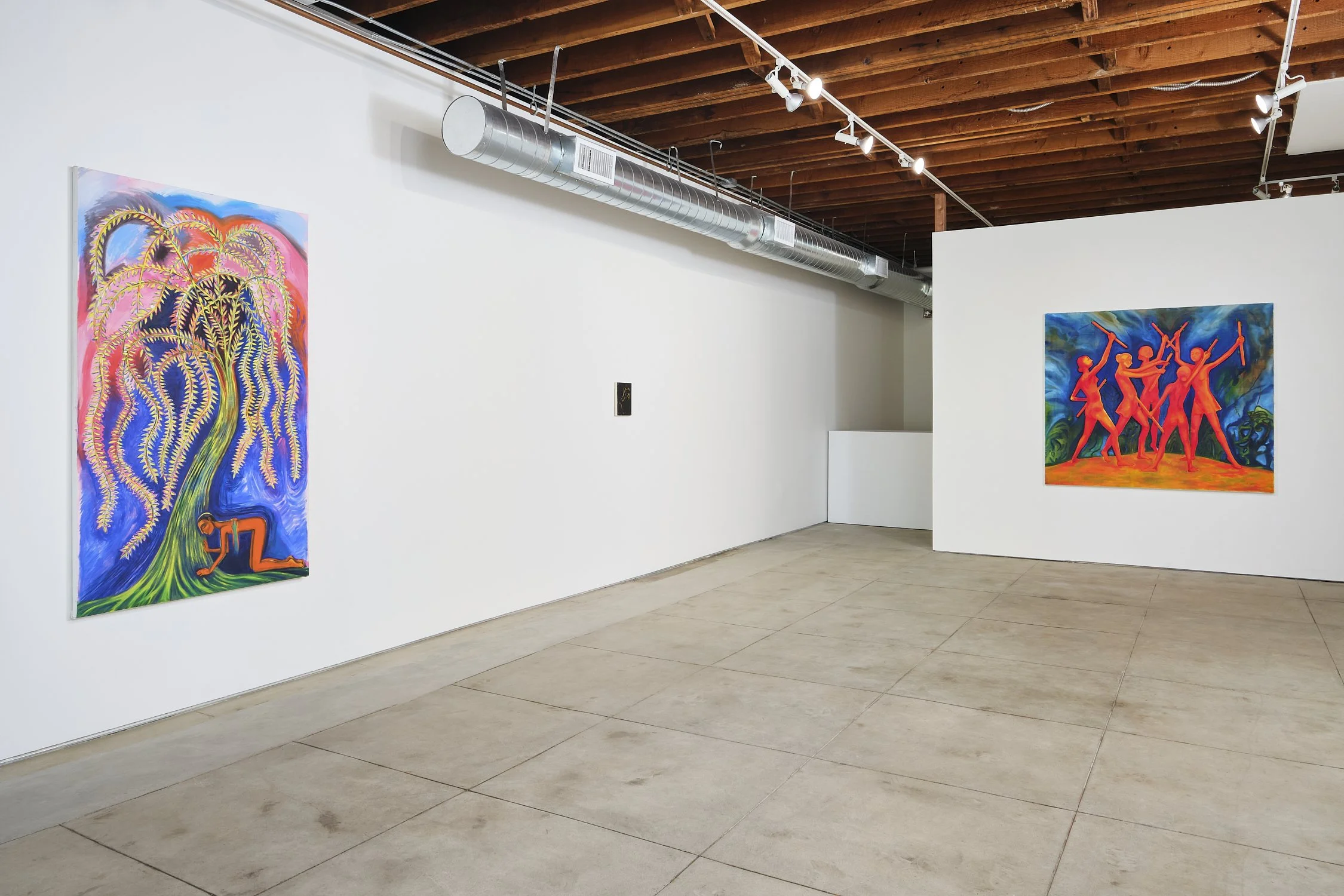
Cecilia Granara’s solo exhibition Tempesta at Charlotte Call Gallery, Los Angeles.
Rather than offering fixed narratives, your paintings invite open interpretations. How do you hope viewers feel after they encounter this body of work?
I hope viewers feel invited to create their own allegory. An allegory is a story we tell ourselves to illustrate a symbolically deeper truth about life.
When Charlotte asked for literary references connected to the show, I mentioned Lucie Brock-Broido’s anthology Trouble in Mind, which includes a poem called Boy on the Border of His Own Allegory. I often feel like I’m at the border of my own allegories, trying to understand what the symbols in my paintings mean, yet keeping others’ eyes in mind.
Looking at this body of work now that it is complete, does it feel like a moment of arrival in your practice, or more like the beginning of a new chapter?
What a wonderful question to end the interview.
Honestly, every show, but especially solo shows, feel like they are both arrivals and beginnings. With this show I feel I have ended a cycle, and by integrating what I've learned from this show, I’ll be starting a new chapter. And, as it’s my first solo show in the United States, it also feels like the beginning of a relationship with something quite unknown.