Reframing Iconography with Dominique Fung
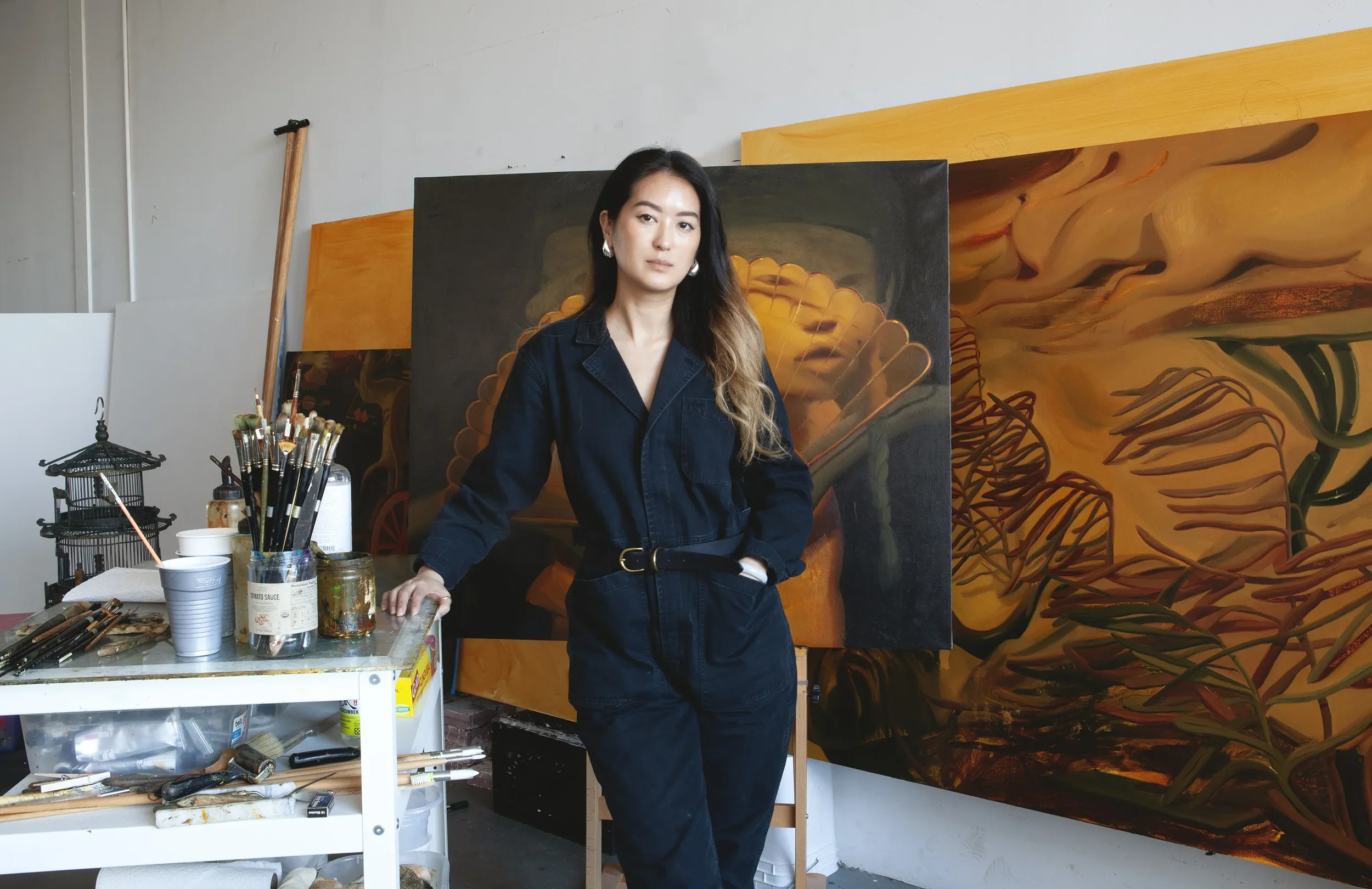
Dominique Fung’s layered paintings blend surreal figuration with historical motifs, exploring identity, memory, and the reframing of Eastern iconography through a contemporary lens. The artist approaches painting as a site of excavation, drawing upon ancient Asian artefacts, archival research, and literary references to construct spaces where beauty and unease quietly coexist. Ornate surfaces and seductive palettes invite the viewer inward, only to reveal more complex undercurrents beneath. At once luminous and psychologically charged, Fung’s practice unfolds at the intersection of personal memory, mythology, and history – where the past is neither fixed nor forgotten, but woven into the present through the narratives she constructs. Through this layered visual language, her paintings become immersive environments in which cultural inheritance is both preserved and quietly reimagined.
Dominique Fung (b. 1987, Canada) is an artist with family roots in Hong Kong and Shanghai, and currently lives in Brooklyn, New York. Her paintings and installations have been exhibited internationally in solo and group exhibitions, including Beneath the Golden Canopy, Massimo De Carlo, Hong Kong (2025), A Tale of Ancestral Memories at Rockefeller Center, New York (2023), (Up)Rooted, Massimo De Carlo, London (2023), and Objects for Comfort in the Afterlife at Pond Society, Shanghai (2022). Her work is included in major museum and institutional collections such as Los Angeles County Museum of Art, Hammer Museum, High Museum of Art, ICA Miami, and the Cantor Arts Center, as well as in private foundations including K11 Art Foundation and Aïshti Foundation.
What brought you into the art world? Are there any memories from your childhood that you now see as formative in your journey to becoming an artist?
I came into the art world slowly, through curiosity. As a child, I was always drawing and making small worlds for myself, but what stayed with me most were objects, fables, and stories; visiting relatives in Canada and in Asia, and seeing ceramics, scrolls, embroidered textiles, things that carried time inside them. I didn’t think of it as “art” then; it just felt like being surrounded by history and memory.
Looking back, growing up between cultures deeply shaped me. There was always this quiet negotiation between past and present, myth and reality. Painting became a way to hold those layers together. I think I became an artist because I wanted to understand where I stood in that continuum.
Describe your work in three words.
Luminosity, psychological, and time-layered.
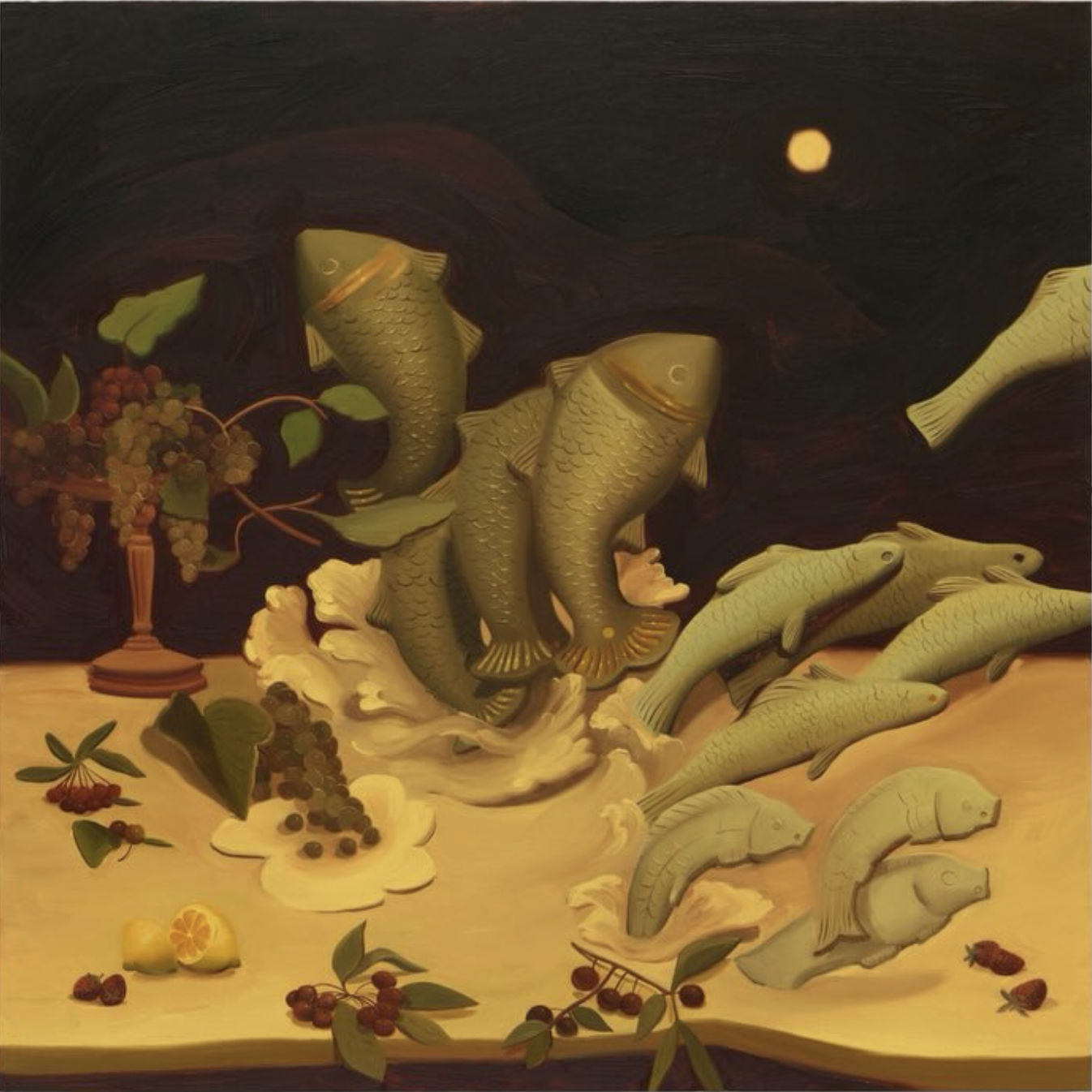
A Table Set for a Low Tide, 2025, oil on canvas. 48”x48”
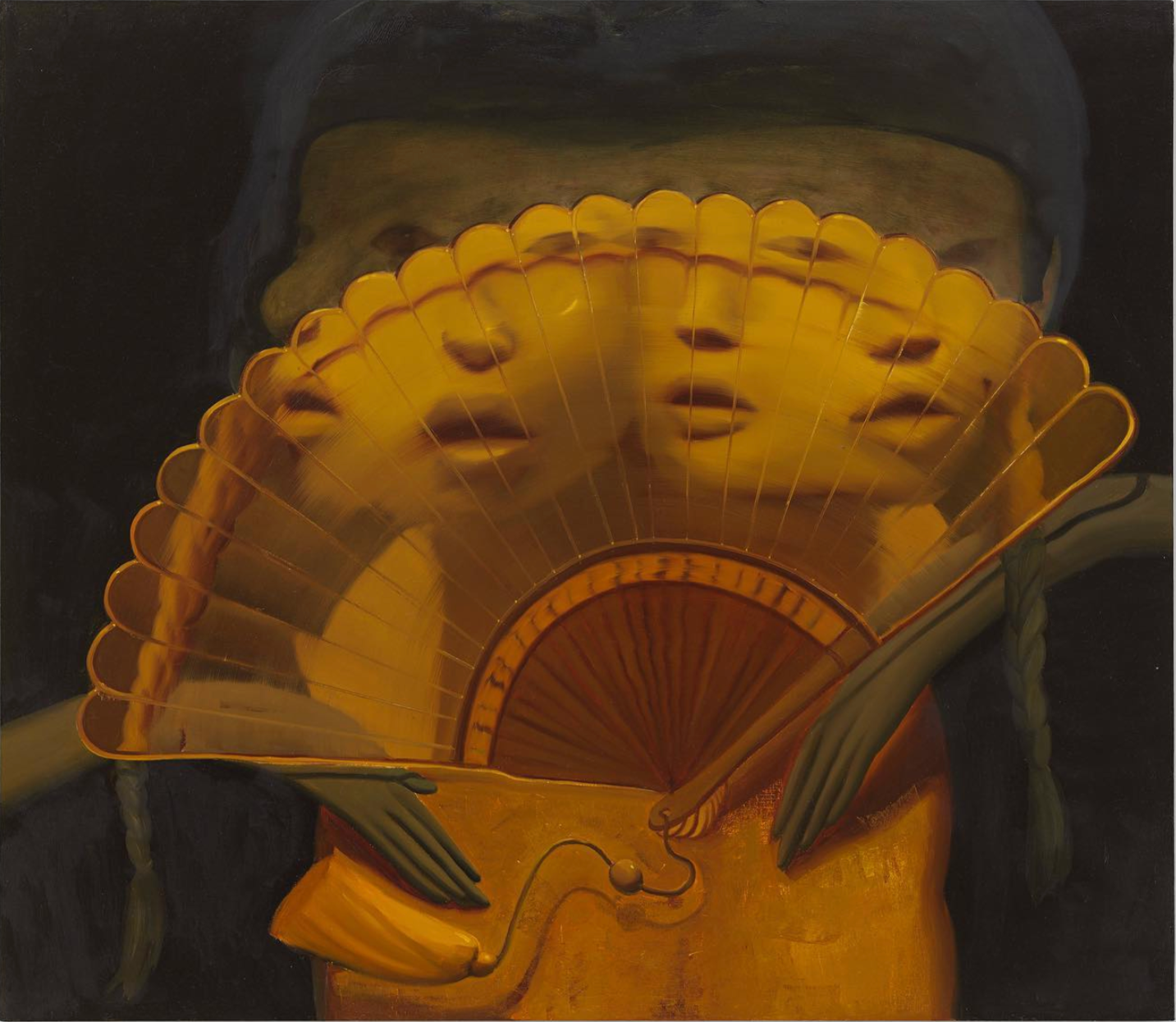
Bone Holding Fan, 2021, oil on linen, 40”x46”
Your paintings are layered with Asian artefactual references and often mask a more unsettling tone beneath a seductive, surreal surface. What draws you to explore this tension between beauty and unease?
History is rarely gentle. When you look closely at beautiful objects, whether paintings, ceramics, or decorative motifs, they often emerge from periods of upheaval, trade, power, or loss. I’m interested in that contradiction.
Beauty can be a seduction, a way to draw the viewer in. But once inside, I like to complicate the experience. Unease creates space for reflection. It mirrors how cultural identity can feel ornate on the surface, but emotionally complex underneath.
Your practice feels as though it sits between archival research and personal mythology. Can you describe your creative process?
My process often begins with research: reading, museum visits, historical imagery, poetry, or specific dynastic periods. I collect fragments, motifs, symbols, and narratives, almost like a visual archive.
But the paintings are never illustrations of exact history. They’re more like translations. I filter everything through personal memory and imagination, allowing figures and symbols to drift into new relationships. The final work sits somewhere between fact and fiction, as a story remembered imperfectly.
I was thrilled that you created a work on plywood for Art on a Postcard’s International Women’s Day auction. The fish is a recurring motif in your practice - could you speak about its symbolic meaning for you?
Fish carry many meanings across cultures: abundance, prosperity, transformation, and freedom of movement. I’m drawn to how they exist between worlds, gliding through water the way memories move through time.
I’m also deeply interested in how fish appear in Chinese art history, from Shang dynasty jade and bronze carvings to Warring States sculptures, where the fish is both ornament and omen. These objects weren’t just decorative; they often held cosmological or ritual significance. I’m fascinated by how a simple aquatic form could carry spiritual weight and encode belief systems.
For me, fish can represent intuition and emotional undercurrents. They’re quiet but alive. Sometimes they feel like witnesses inside the painting, moving between history and the present, between the seen and the felt.
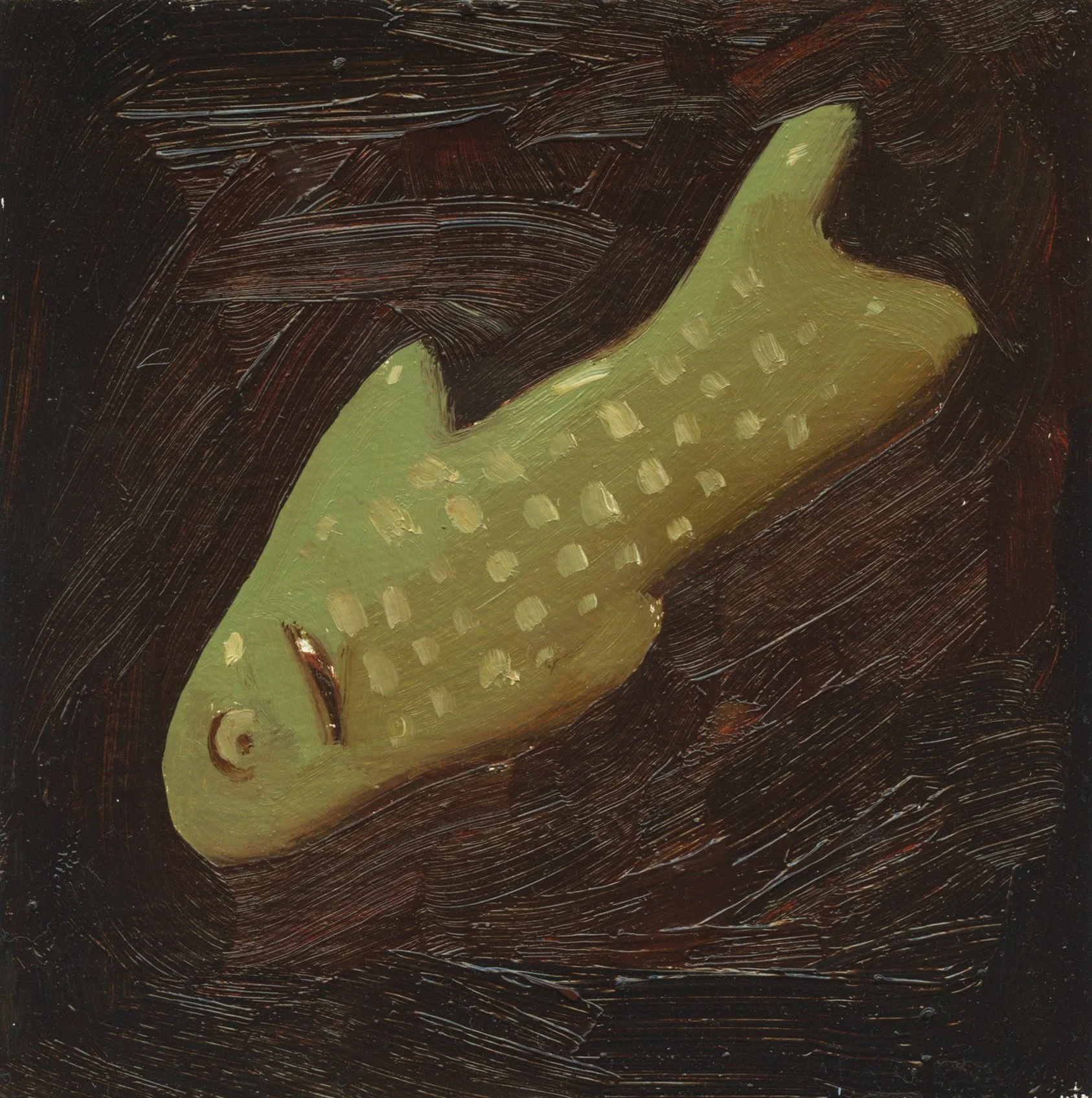
Dominique Fung’s creation for AOAP International Women’s Day charitable auction
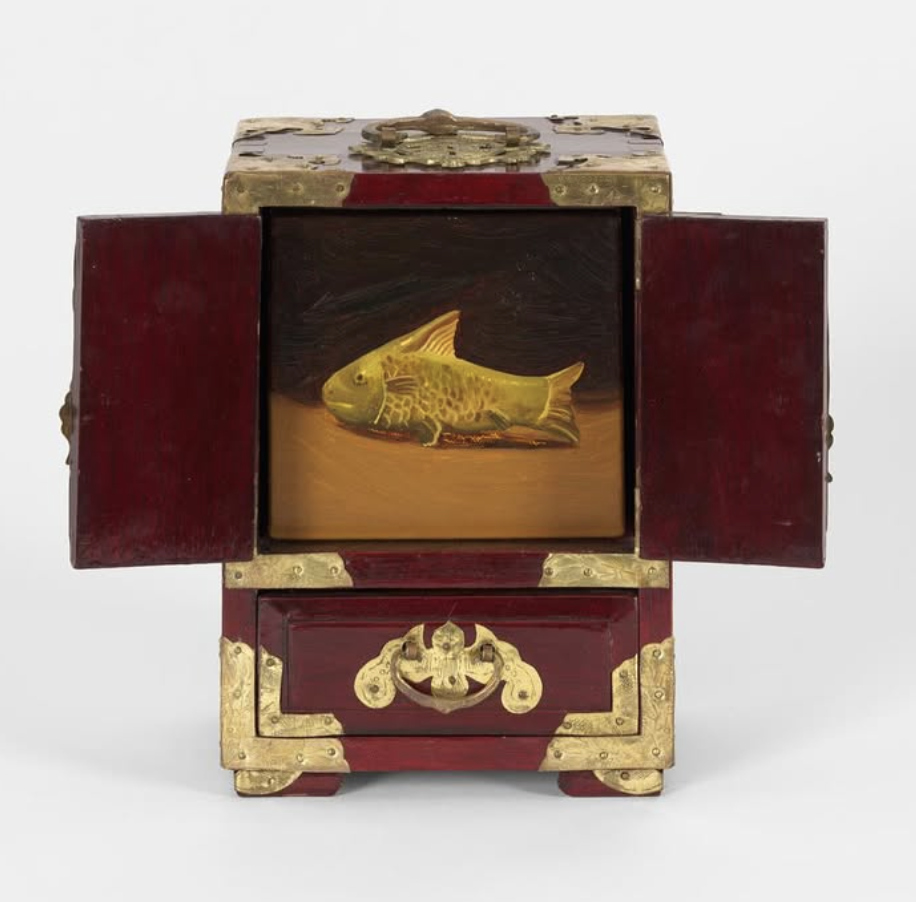
Warring States Fish, 2024 - 2025. Oil on canvas and antique jewellery box.
8 3/4” × 6” × 4 3/4”
As this work was created for International Women’s Day, can you speak a little about how women’s perspectives inform the historical and cultural references in your work?
Much of recorded history is told through male perspectives, but women have always been present as makers, muses, laborers, and storytellers. I’m interested in gently re-centering those presences.
There are so many incredible, lesser-told stories of women that I’m drawn to, from the sea women of Jeju Island who built entire livelihoods through diving and collective resilience, to figures like Ching Shih, the formidable pirate leader of the South China Sea. These histories are layered, dramatic, and deeply human. They challenge narrow ideas of what women’s roles looked like in the past.
In my work, women are not just subjects but carriers of atmosphere and agency. Their gestures, gazes, and relationships to objects subtly reshape the narrative. It’s less about rewriting history and more about revealing what's always been there. I think people are hungry for these stories, which expand our understanding of history, and I enjoy bringing them back to life.
Are there any artists, writers, or cultural references, historical or contemporary, that have shaped the way you think about painting?
I’m inspired by many sources, classical Chinese painting and poetry, Dutch painting, surrealist artists, theatrical staging, cinema, and literature. I love when imagery carries symbolic weight but remains open-ended.
Writers who blend history and emotion, and artists who build worlds rather than single images, resonate with me. I’m drawn to anything that feels timeless yet psychologically present.
You are an inspiration to so many younger artists. What advice would you give to your younger self?
Protect your curiosity and don’t rush clarity. It takes time to understand your voice. Early on, I thought I needed a fixed identity, but practice is actually a long unfolding.
Pragmatic advice: learn the business side sooner and make sure you understand your finances (don’t ignore them). It gives you freedom to protect your work and your energy.
What are you currently working on, and what feels most exciting in your practice right now?
Right now, I’m excited by work that moves beyond the canvas, installations, performance, and immersive environments. I’m thinking a lot about ritual, storytelling, and how audiences physically move through a narrative.
It feels like an expansion of painting into lived space. The most exciting part is creating experiences that feel both intimate and cinematic, where history, myth, and the present moment coexist. I’ll be presenting some of these works in my upcoming two-person solo exhibitions with Heidi Lau at the Institute of Contemporary Art in San Francisco.